
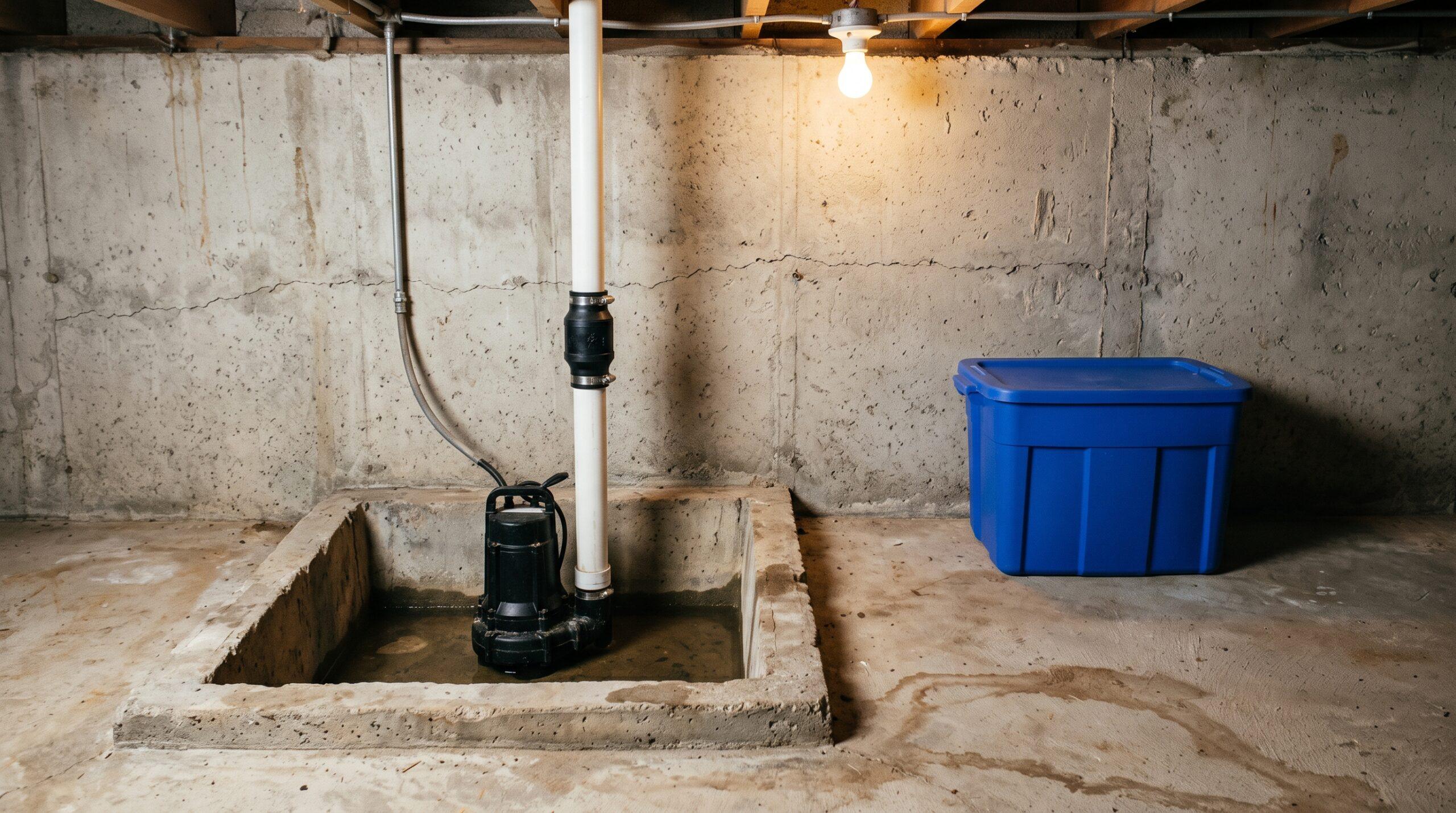
9 min read · Last updated October 19, 2026
- A sump pump typically lasts 7 to 10 years depending on how hard it works, according to Zoeller’s own technical guidance, so a pump already in that window carries real failure risk heading into wet season.
- A standard homeowners policy does not automatically cover damage from a sump pump failure. North Carolina’s insurance regulator notes insurers may not even offer the water-backup endorsement unless you specifically ask for it.
- One real insurer’s own Texas filing shows how thin the built-in protection can be: the automatic water-backup limit is $5,000, raised to $10,000 for a flat $1,000 deductible if you add the endorsement.
- Adding or raising water-backup coverage typically costs $30 to $70 a year for each $5,000 of protection, far less than a single basement cleanup.
Whether to replace a sump pump before it fails usually comes down to two separate questions: how close the pump is to its 7-to-10-year expected lifespan, and whether your homeowners policy’s water-backup endorsement, if you have one at all, would actually cover what a failure costs.
In this article
- How old is too old: signs to replace an aging sump pump
- Battery backup vs. water-powered backup
- What your water backup endorsement actually pays
- The verdict: replace now or wait
- Frequently asked questions
Replace an aging sump pump once it passes 7 to 10 years old and shows real wear, not simply because wet season is coming. Say a homeowner named Carla has a submersible sump pump that’s 9 years old. It still runs every time it rains, so she’s trying to decide whether to replace it now or wait until it actually dies.
How old is too old: signs to replace an aging sump pump
Zoeller, one of the largest sump pump manufacturers, puts the typical lifespan at 7 to 10 years depending on the application. A pump that works hard, cycling often in a high-water-table lot, tends to land at the low end of that range. A lightly used pump in a dry basement can run longer.
Age alone isn’t the only signal. Watch for the motor running longer per cycle than it used to, or cycling on and off more frequently than normal rainfall would explain. A new grinding, rattling, or humming noise, rust-colored or cloudy discharge water, and a float switch that sticks or hangs up are all signs the pump is nearing the end of its working life, regardless of its exact age.
Carla’s pump is quiet and cycles normally, but at 9 years old it sits inside Zoeller’s own replacement window. That alone is a reason to plan for replacement soon, whether or not it fails this season.
A sump pump isn’t the only buried home system with a fixed working life and a repair-or-replace decision attached to it. The same age-and-signs logic applies to a home’s main sewer line, covered in our sewer line repair vs. replacement guide.
Battery backup vs. water-powered backup
A backup system buys time during a power outage, the single most common reason a working sump pump suddenly stops moving water. There are two real options, and they trade off differently on cost and reliability.
A battery backup runs on a marine-style deep-cycle battery. It works regardless of water pressure, but it slows down as the battery drains and eventually stops once the charge runs out.
A water-powered backup uses your home’s own water pressure to eject water, with no battery to maintain, but it only works as long as a pressurized water supply is actually flowing. A home on a well loses that supply in the same outage that knocked out the primary pump, since the well’s own pump needs electricity too.
| Factor | Battery backup | Water-powered backup |
|---|---|---|
| Typical unit cost | $150-$250 add-on kit; $150-$2,000 for a pump with backup built in | $200-$900 for the unit alone |
| Power source | Deep-cycle battery, charges off house power | Household water pressure, no electricity needed |
| Performance over time | Pumping rate slows as the battery drains | Steady rate as long as water pressure holds |
| Maintenance | Battery needs periodic load-testing and replacement | No battery, but depends on supply pressure staying intact |
| Key limitation | Eventually dies mid-outage if power stays out long enough | Won’t run if the home is on a well, since the well pump also loses power |
| Best for | Any home, especially shorter outages or a well-water supply | Homes on municipal water with long or frequent outages |
Neither backup system replaces an aging primary pump. Both exist to cover the gap during a power outage; a primary pump that’s simply worn out will still fail on a clear, sunny day with full power running.
What your water backup endorsement actually pays
A standard homeowners policy treats sump pump failure as water damage it doesn’t pay for. North Carolina’s Department of Insurance states plainly that losses from water backup and sump overflow are not covered under a standard homeowners policy, and that the coverage exists only as an add-on endorsement that some insurers won’t even mention unless you ask.
Sump pump failure sits inside a wider set of water-related gaps most policies carry by default. For the fuller picture, see our breakdown of what homeowners insurance doesn’t cover.
When insurers do sell the endorsement, the starting limit is often smaller than homeowners assume. One real example: Homeowners of America Insurance Company’s own Texas filing includes $5,000 of water-backup coverage automatically, and lets a policyholder raise that to $10,000 for a flat $1,000 deductible by adding the endorsement. Limits and deductibles vary by carrier and state, but the structure, a low automatic amount with a scheduled upgrade, is common.

Run that structure against a real basement. Carla’s basement is 900 square feet and unfinished. Her pump is 9 years old, and she has no water-backup endorsement; she was never offered one and never thought to ask.
If her pump fails during a heavy storm and clean groundwater floods the space, extraction alone runs $3.75 to $4.25 per square foot, according to Fixr’s restoration cost data. For 900 square feet, that’s $3,375 to $3,825, roughly $3,600 at the midpoint, for extraction before any drying, drywall, flooring, or mechanical repairs add to the bill. Without the endorsement, every dollar of that comes out of her own pocket.
A battery backup or water-powered unit would help her avoid an outage-driven failure, running $150 to $900 depending on the type. But adding the water-backup endorsement itself costs $30 to $70 a year for the first $5,000 of coverage, with roughly $25 to $35 for each additional $5,000.
Stacking two tiers to reach a $10,000 limit, the kind of upgrade the Texas example above shows as a real option, runs under $150 a year. That’s less than one-twentieth of the $3,600 cleanup bill her policy would otherwise leave her to cover alone.
The same math changes if Carla’s basement were finished instead of bare concrete. Carpet, drywall, and hardwood all restore at a higher per-square-foot rate than bare extraction, so a $5,000 or even $10,000 limit can disappear fast once finished materials are involved. That’s the real adequacy question: not whether you have the endorsement, but whether its limit matches what your specific basement would actually cost to dry out and rebuild.
A finished basement raises a second, separate question worth checking at the same time: that same below-grade square footage usually doesn’t count toward your home’s official size on an appraisal. Our guide on how a finished basement factors into appraisal value covers that side of the tradeoff.
The verdict: replace now or wait
Replace the pump now if it’s past 7 to 10 years old and shows any of the wear signs above, especially if the basement is finished or holds anything you’d hate to lose. Replace it now too if you currently carry no water-backup endorsement at all, since pump failure is the exact scenario that coverage exists for, and a new pump plus a backup system is cheap insurance against ever needing to file that claim.
Wait if the pump is younger, shows no wear signs, and your endorsement limit already matches your basement’s real cleanup cost. In that case, the better near-term move is adding a battery or water-powered backup for outage protection, not replacing a pump that’s doing its job.
Either way, the smaller, nearly free step is the phone call: ask your agent whether you have the water-backup and sump-discharge endorsement at all, and whether its limit actually covers your basement’s square footage at today’s cleanup rates. That call takes five minutes. A flooded, uninsured basement does not.
Frequently asked questions
How do I know my sump pump is about to fail? Watch for a pump that runs longer per cycle, cycles on and off more often than normal rainfall explains, or makes a new grinding or rattling noise. Rust-colored or cloudy discharge water and a sticking float switch are also warning signs. A pump already past 7 to 10 years old showing any of these is a strong candidate for replacement.
Does homeowners insurance automatically cover a basement flooded by a failed sump pump? No. A standard homeowners policy excludes water-backup and sump-overflow damage by default. North Carolina’s insurance regulator notes this coverage exists only as an optional endorsement, and some insurers won’t offer it unless you specifically ask.
Is a battery backup or a water-powered backup better for a sump pump? A battery backup costs less and works regardless of water pressure, but it slows down and eventually dies as the battery drains. A water-powered backup can run as long as pressure holds, but it depends on a water supply that can fail in the same outage, especially on a well.
Does a water-backup endorsement cover replacing the sump pump itself? The endorsements reviewed here describe paying for the water damage that results from a backup or overflow, not the pump or its parts. Coverage of the equipment itself varies by policy, so confirm the exact wording with your agent before assuming either way.
How much does it cost to add water-backup coverage to a homeowners policy? Water-backup coverage typically costs $30 to $70 a year for the first $5,000 of protection, with roughly $25 to $35 for each additional $5,000. That’s a small fraction of what a single basement cleanup can cost without it.
Should I replace a sump pump that still works before the wet season? Replace it proactively if it’s past 7 to 10 years old, shows wear signs, or you lack adequate water-backup coverage. If it’s newer, quiet, and your endorsement limit already matches your basement’s cleanup cost, adding a backup system is the more useful near-term step.