
7 min read · Last updated October 19, 2026
- Refinancing a $340,000 mortgage at an example 3.25% rate into a $380,000 cash-out loan to cover a $40,000 project reprices the entire balance to today’s 7.40% Freddie Mac rate, not just the new money.
- A Home Equity Line of Credit (HELOC) borrows only the $40,000 needed for the project. The original mortgage and its rate stay exactly as they were.
- In this example, the blended rate across both loans under the HELOC path works out to about 3.67%, versus a flat 7.40% under the cash-out refinance, a 3.73 percentage point gap on the same $380,000.
- The HELOC path’s combined monthly payment runs about $732 lower than the cash-out refinance in this example, close to $8,790 a year.
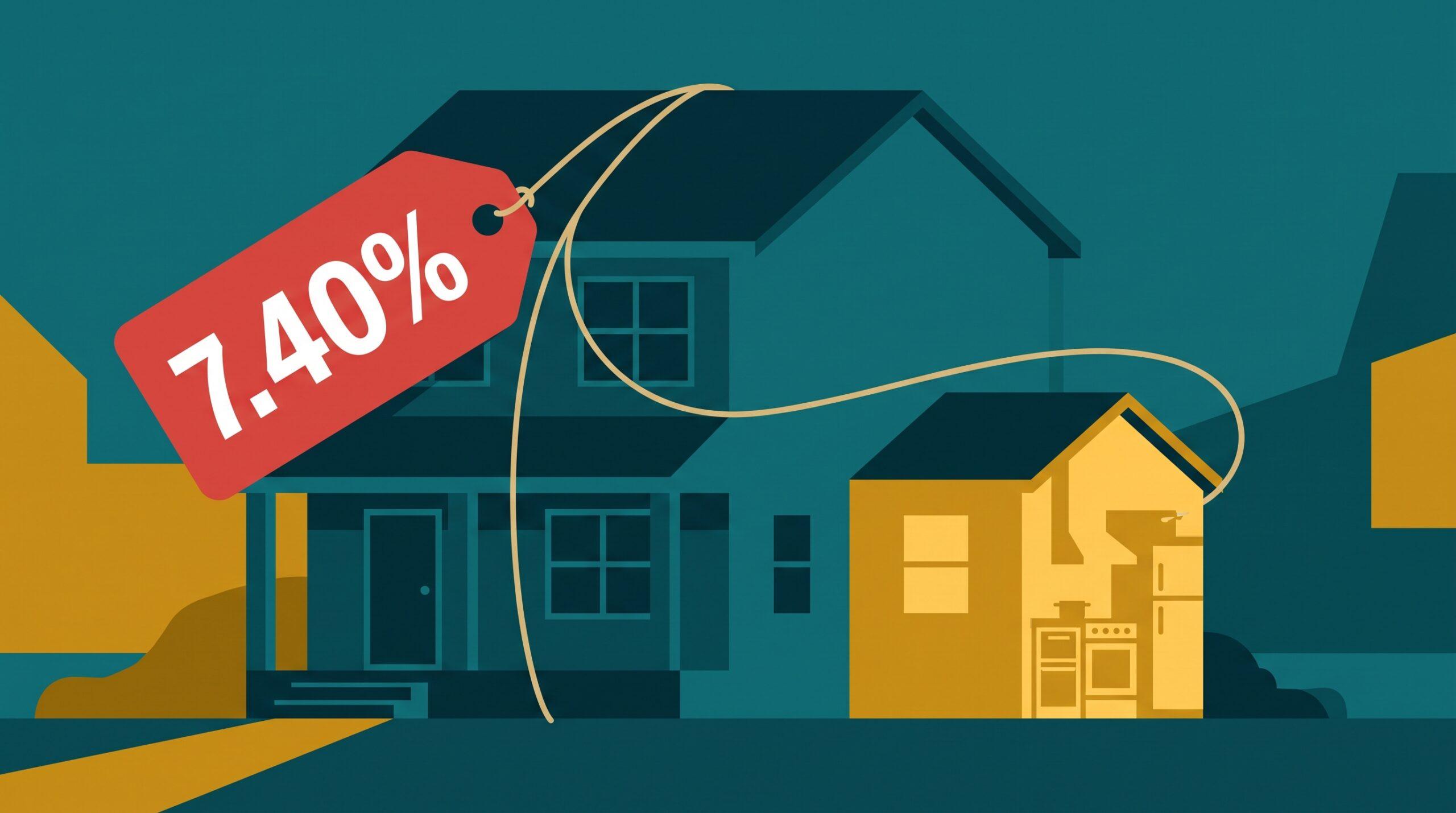
On a $340,000 mortgage held at an example 3.25% rate, a cash-out refinance to fund a $40,000 kitchen reprices the full $380,000 balance to today’s 7.40% Freddie Mac rate, while a Home Equity Line of Credit (HELOC) borrows only the $40,000 and leaves the 3.25% rate on the original balance untouched.
In this article
- What a cash-out refinance actually reprices
- What a HELOC leaves alone
- The blended-rate math on a $340,000 balance and a $40,000 kitchen
- Cash-out refinance vs HELOC: side by side
- The verdict: when the math flips
- Frequently asked questions
A cash-out refinance to pay for a $40,000 kitchen does not just charge today’s rate on the $40,000. Say your existing mortgage carries a 3.25% rate from a 2021 purchase or refinance, a realistic example for anyone who bought or refinanced before rates climbed. Rolling a $40,000 project into a new, larger mortgage replaces that entire loan, so the new rate applies to every dollar you already owed too, not just the project money.
A HELOC works differently. It borrows only the new $40,000, and the original mortgage keeps its original rate untouched.
What a cash-out refinance actually reprices
A cash-out refinance is not a second loan stacked on your first. It pays off your current mortgage entirely and replaces it with one new loan for a bigger amount: the old balance plus the cash you’re taking out.
Say you owe $340,000 on a mortgage at 3.25%, and you want $40,000 for the kitchen. A cash-out refinance creates one new $380,000 loan.
Freddie Mac’s Primary Mortgage Market Survey (PMMS), the weekly benchmark most lenders price against, put the average 30-year fixed rate at 7.40% as of October 15, 2026, unchanged from the week before. That rate does not apply only to the new $40,000. It applies to the full $380,000, including the $340,000 you were already paying down at less than half that rate.
A refinance is a single new loan with a single interest rate, by definition. The cost shows up in what that one rate does to a balance that used to cost far less.
What a HELOC leaves alone
A Home Equity Line of Credit is a second, separate loan. Your existing mortgage is not touched, paid off, or reissued.
In the same example, your $340,000 mortgage keeps its 3.25% rate and its original payoff schedule. A HELOC for $40,000 sits beside it as its own loan, with its own separate rate.
A HELOC’s rate is variable and tracks the prime rate, not the 30-year mortgage rate Freddie Mac tracks. The Federal Reserve’s own H.15 release put the bank prime rate at 7.00% for the full week of October 9 through October 15, 2026. Lenders add their own margin on top of prime, so a HELOC rate ends up somewhere above that figure, not identical to it.
Navy Federal Credit Union, for example, currently advertises its standard home equity line starting at 7.250% annual percentage rate (APR, the all-in yearly cost of borrowing), for a borrower with a 750 credit score, a primary residence, and no more than 70% of the home’s value borrowed against it, including the new line. That is one representative example, not a universal rate. Every lender prices its own margin differently.
For the fuller rundown of fees, draw periods, and qualifying rules on each option, see our comparison of a HELOC versus a cash-out refinance. This article focuses specifically on the repricing mechanic that comparison does not cover in depth.
The blended-rate math on a $340,000 balance and a $40,000 kitchen
The numbers below use the same inputs throughout: a $340,000 existing mortgage at an example 3.25% rate, a $40,000 kitchen project (the midpoint of a typical $35,000 to $45,000 remodel), a new 30-year term for the refinance, and 25 years remaining on the existing mortgage.
Refinance path: a new $380,000 loan at 7.40% over 30 years runs about $2,631 a month in principal and interest. The current mortgage’s $1,657 payment disappears into that one new number.
HELOC path: the $340,000 mortgage keeps its $1,657 monthly payment unchanged. A $40,000 HELOC at an example 7.25% rate, interest-only during a typical draw period, adds about $242 a month. Combined, that’s $1,899.
That’s a $732-a-month gap, about $8,790 a year, for financing the identical $40,000 project. The difference is not the kitchen. It is what happens to the other $340,000.

Expressed as one blended rate across both balances, the HELOC path works out to roughly 3.67%, a weighted average of 3.25% on $340,000 and 7.25% on $40,000. The refinance path has no blend to compute. Every dollar of the new $380,000 loan sits at one flat 7.40% rate, a 3.73 percentage point gap on the same total balance.
Cash-out refinance vs HELOC: side by side
The mechanics behind that gap hold regardless of the exact dollar amounts involved.
| Factor | Cash-out refinance | HELOC |
|---|---|---|
| What gets repriced | The entire mortgage balance, old and new money combined | Only the new amount drawn; the original mortgage is untouched |
| Rate applied | One new fixed rate on the full balance (7.40% in this example) | A separate variable rate on just the draw, tied to the prime rate (7.250% APR in this example) |
| Typical closing costs | 2% to 6% of the new loan amount | Often $0 to a few hundred dollars; some lenders waive them |
| Access to funds | One lump sum at closing | Revolving access during the draw period: borrow, repay, redraw |
| Best for | A homeowner whose current rate is already near or above today’s rate | A homeowner holding a mortgage rate well below today’s rate |
The verdict: when the math flips
None of this makes a HELOC automatically the right call. The repricing penalty only exists because the example mortgage rate, 3.25%, sits well below today’s 7.40% rate.
If your own current rate is already close to or above today’s rate, a cash-out refinance stops costing you anything extra on the old balance, since there’s little or no gap left to reprice. In that situation, refinancing can make sense, especially if you’d also like to shorten your term or move off an adjustable rate.
The decision rule is simple: compare your current mortgage rate to today’s Freddie Mac average before comparing loan products. The bigger that gap, the more a HELOC’s narrower scope is worth the separate loan, the separate payment, and the shorter typical repayment window.
Frequently asked questions
Does a cash-out refinance really change the rate on my whole mortgage, not just the new money?
Yes. A cash-out refinance pays off your existing mortgage and replaces it with one new loan covering the combined balance.
Every dollar, old balance and new project money, carries the new rate. If your existing rate sits well below today’s rate, that repricing is usually the bigger cost, not the project itself.
Why doesn’t a HELOC’s rate need to beat my mortgage rate?
A Home Equity Line of Credit charges its rate only on the amount you actually draw, not your whole mortgage. Even when the HELOC rate runs close to or above today’s mortgage rate, it applies to a much smaller balance, so the blended cost across both loans typically stays lower than refinancing everything.
Is a HELOC always the cheaper way to pay for a renovation?
No. If your current mortgage rate already sits close to or above today’s rate, repricing it costs little or nothing, and a cash-out refinance can make sense, especially if you also want a lower rate or a different term. The repricing penalty only applies when your existing rate sits well below the current one.
What happens to a HELOC payment once the draw period ends?
Most HELOCs charge interest only for a set draw period, often 10 years, then switch to a fully amortizing repayment period that can run 15 to 20 years. That switch raises the payment, sometimes sharply. Our guide to the draw-period payment jump walks through the math.
Does my credit score affect which option actually costs less?
Yes. Your credit score and available equity affect the rate you’re offered on either a refinance or a HELOC. A lower score can narrow or erase a HELOC’s rate advantage, so compare your own quoted rates on both before assuming the HELOC automatically wins.