
7 min read · Last updated November 16, 2026
- ENERGY STAR’s own climate-zone table calls for R-60 in an uninsulated attic across zones 4A through 8, or R-49 if you already have a few inches down.
- Blown-in cellulose runs $1.67 to $2.92 per square foot installed as of May 2026, per Homewyse’s national cost data.
- Air sealing the attic bypasses first is not optional. ENERGY STAR’s own guide sequences it before adding insulation, because insulation laid over an open leak loses much of its value.
- On a 1,500 sq ft attic, a full top-up runs roughly $2,500 to $4,400, with a realistic payback of 7 to 12 years once you apply the Environmental Protection Agency’s (EPA) own savings estimate.
Most cold-climate homes should carry R-49 to R-60 in the attic, not the R-38 figure that still circulates in general advice, and a 1,500 sq ft top-up typically costs $2,500 to $4,400 installed.
In this article
- How much attic insulation you actually need
- Why air sealing has to come first
- What a real top-up costs
- The payback math
- Frequently asked questions
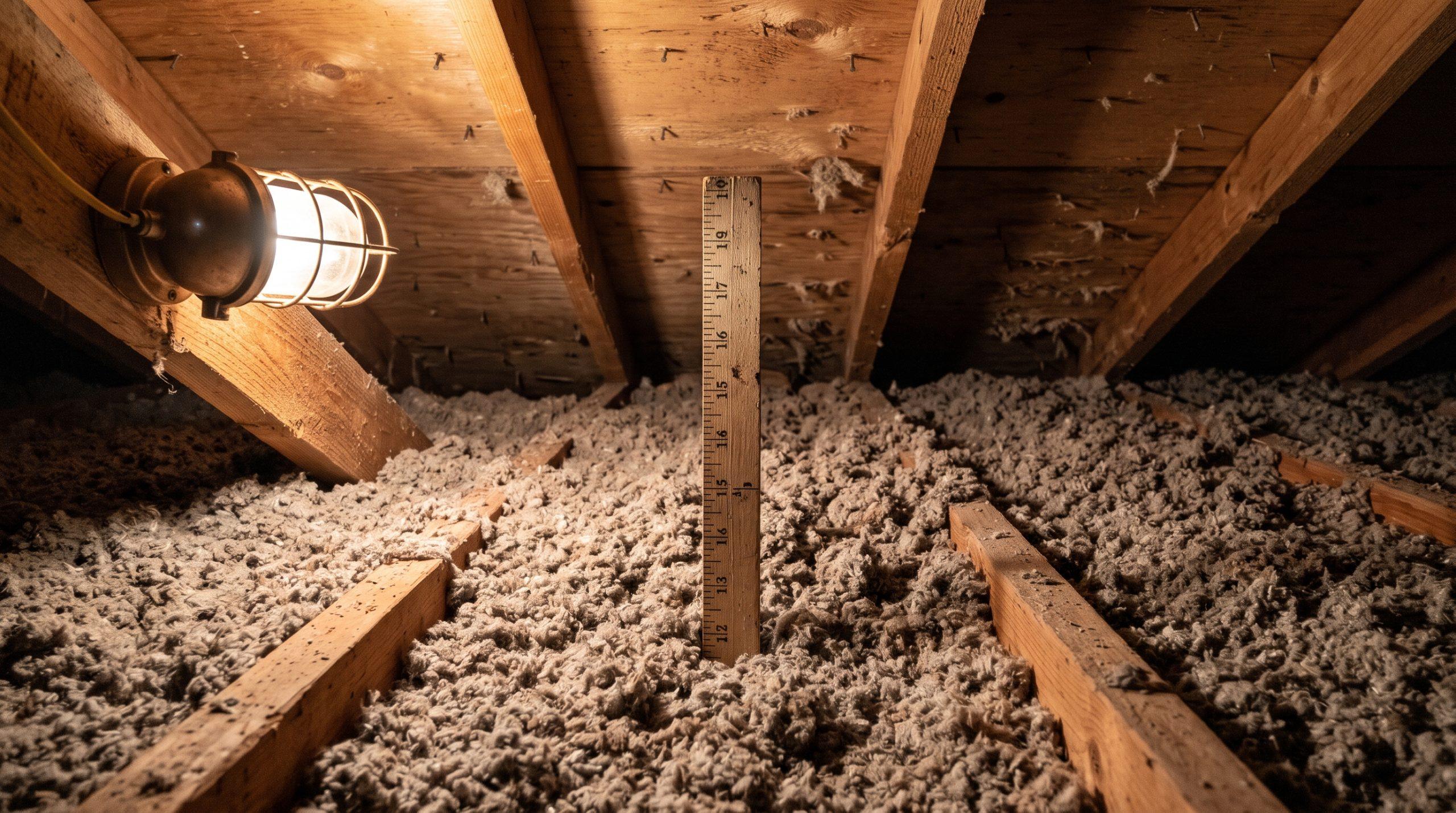
Imagine a homeowner named Carlos in a cold-climate state, checking his attic before the first hard freeze. He can still see the tops of his floor joists through a thin, patchy layer of old fiberglass batts. That’s the visual test ENERGY STAR itself recommends: if you can see your joists, you don’t have enough.
How much attic insulation you actually need
R-value measures how well insulation resists heat flow. Higher R-value means less heat escaping through the attic in winter and less heat soaking in during summer. The number that actually applies to your house depends on where you live, not on a single figure repeated across the internet.
ENERGY STAR’s own insulation guidance, based on the 2021 International Energy Conservation Code (IECC), breaks the country into zones and states a clear target for each one. For the coldest zones, 4A, 4B, 4C, 5, 6, 7 and 8, the recommendation is to bring an uninsulated attic up to R-60, or to add R-49 on top of an attic that already has 3 to 4 inches down. Milder zone 3 calls for R-49 uninsulated or R-38 on top of existing insulation, and zone 1 (the warmest) calls for R-30 uninsulated or R-25 on top of existing insulation.
| Climate zone | If attic is uninsulated, add to | If you already have 3-4 inches, add |
|---|---|---|
| Zone 1 (warmest) | R-30 | R-25 |
| Zone 2 | R-49 | R-38 |
| Zone 3 | R-49 | R-38 |
| Zones 4A, 4B (cold) | R-60 | R-49 |
| Zones 4C, 5, 6 (colder) | R-60 | R-49 |
| Zones 7, 8 (coldest) | R-60 | R-49 |
| Best for | Homeowners with no existing attic insulation | Homeowners topping up an already-insulated attic |
If you don’t know your climate zone, ENERGY STAR’s own insulation page lets you look it up by location, and most of the continental U.S. north of the Mason-Dixon line through New England, the Upper Midwest, the Mountain West, and the northern Plains lands in zone 5 or colder. That is the group this article’s cost math below is built around.
Why air sealing has to come first
Insulation slows heat conduction. It does almost nothing about air moving straight through a gap. ENERGY STAR’s own do-it-yourself guide to adding attic insulation is explicit about the order: check and seal your attic air leaks first, then add insulation on top.
Bury an open gap around a recessed light fixture, a plumbing stack, an attic hatch, or the top plates of an interior wall under a foot of fresh cellulose, and warm household air still finds its way out through that gap. The insulation above it just hides the problem and makes it more expensive to fix later, since a contractor now has to move insulation aside to even find the leak.
This is also where a lot of the real payoff lives. ENERGY STAR’s own “why seal and insulate” guidance states that homeowners who air seal and add insulation together save an average of 15% on heating and cooling costs, or an average of 11% on total energy costs, according to the EPA’s own estimate. That figure covers both projects done together, not insulation alone, which is exactly why skipping the sealing step leaves real savings on the table.
What a real top-up costs

Here’s a worked example using a 1,500 sq ft attic in a cold climate zone, currently sitting at around R-19 (a common starting point for a home with older, settled fiberglass batts), being topped up to the R-60 target for zones 4A through 8.
Blown-in cellulose insulation runs $1.67 to $2.92 per square foot installed, according to Homewyse’s May 2026 national cost data. On a 1,500 sq ft attic, that puts the installed cost at $2,505 on the low end and $4,380 on the high end, for roughly 11 additional inches of cellulose to get from R-19 up toward R-60. A contractor’s actual quote will also depend on access, removing any damaged old insulation first, and whether the air sealing above gets bundled into the same job or billed separately.
The payback math
Say Carlos’s furnace and air conditioner together cost him $2,400 a year to run, a reasonable illustrative figure for a cold-climate home. Applying the EPA’s own 15% average heating-and-cooling savings figure from air sealing and insulating together, that’s $360 a year back in his pocket.
Divide the job cost by that annual savings and the payback period lands between 7 years (on the $2,505 low-end job) and about 12 years (on the $4,380 high-end job). That is a real range, not a guess.
A homeowner planning to stay in the house for a decade or more clears the payback comfortably. A homeowner planning to sell in 3 to 5 years is unlikely to recoup the cost through energy savings alone, though a documented, recent attic top-up can still be a point worth mentioning to a buyer, since an energy-efficient home can affect a buyer’s view of the property’s value.
If the $2,500 to $4,400 range feels like a lot to spend before you’ve even checked your duct work and window seals for other sources of phantom energy loss, that is a fair instinct. Attic insulation is one project in a larger list, and it is worth tackling in the order that actually saves the most: seal the attic first, insulate the attic second, then move to the rest of the house.
Frequently asked questions
Is R-38 still a good target for attic insulation? Not for most of the country. R-38 is an older, generic figure. ENERGY STAR’s current climate-zone table calls for R-49 to R-60 in zones 4A through 8, which cover most of the northern and mountain United States. Check your actual zone before assuming R-38 is enough.
How do I know if my attic needs more insulation? ENERGY STAR’s own quick check is visual: if you can see the tops of your floor joists through the insulation, you likely don’t have enough. If the insulation sits well above the joists and is distributed evenly with no bare patches, you probably meet or exceed the minimum.
Should I air seal and insulate in the same visit? It’s the more efficient order either way, but ENERGY STAR’s own guide sequences air sealing before insulation specifically, not as a bundling convenience. Insulation added over an unsealed leak performs worse and makes the leak harder to find and fix later.
Can I add blown-in insulation over my existing batts? Yes. ENERGY STAR notes you can add loose-fill insulation over existing fiberglass batts or blankets, and the reverse, as long as any fiberglass batt added on top is unfaced, with no paper or foil backing.
Is a 7-to-12-year payback actually worth it? That depends on how long you plan to stay in the house and how much you value the comfort difference, not just the dollars. If you’re staying 10+ years, the energy savings alone clear the cost. If you’re selling in the next few years, treat the comfort improvement and the selling point as the real payoff, not the energy bill.