
Affiliate disclosure: Some links in this article are affiliate links. We may earn a commission if you click and make a purchase, at no extra cost to you. Editorial decisions are independent of any commission we earn.
What Homeowners Insurance Pays For
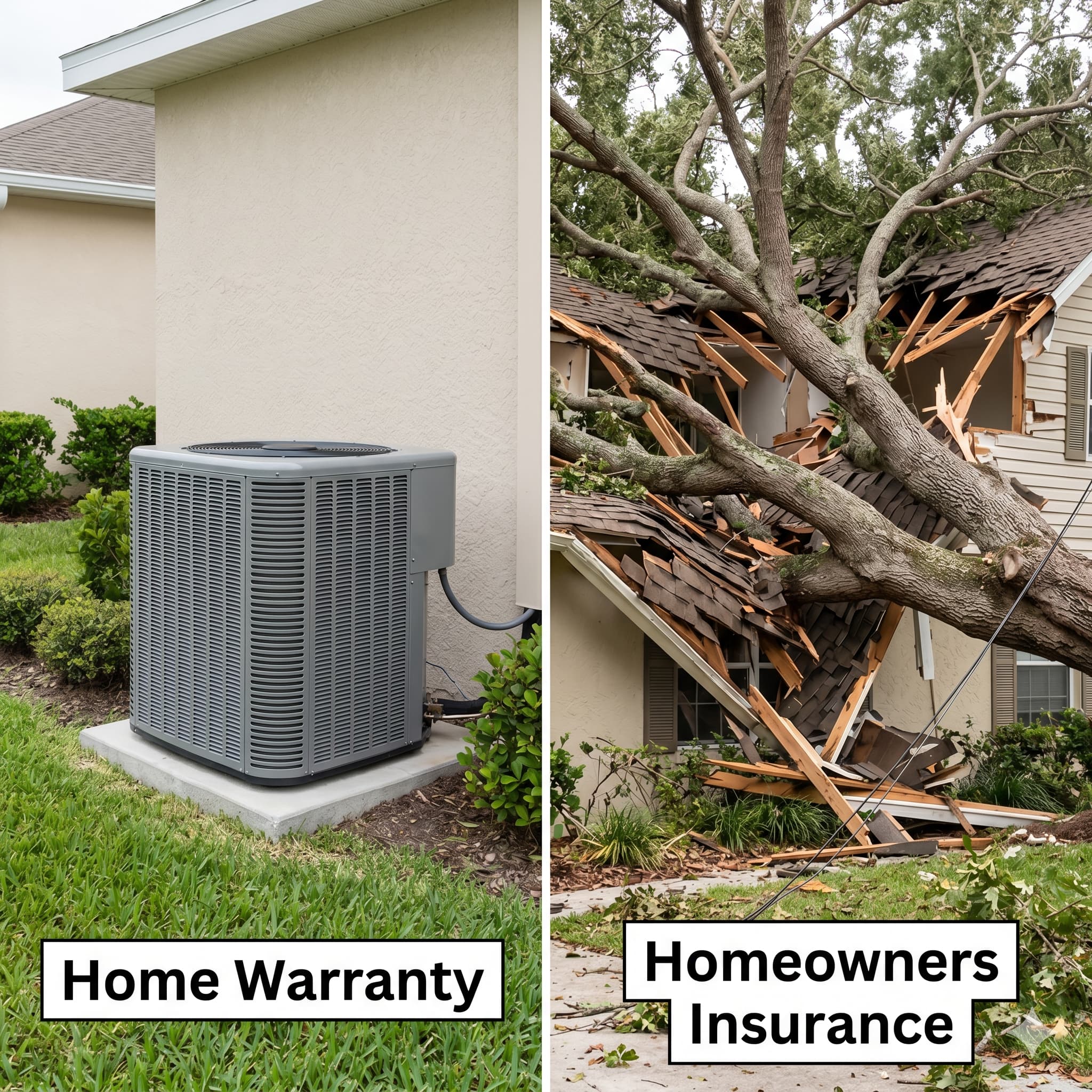
Homeowners insurance covers sudden, accidental damage caused by external events. Fire, windstorm, hail, a tree falling on your roof, a burst pipe that floods your living room, theft. The event must be unexpected and typically must come from outside the home’s systems themselves.For coverage basics, NAIC’s homeowners insurance guide explains what policies are designed to cover and where exclusions matter. For disaster recovery, USA.gov lists federal disaster-assistance resources homeowners can check after a covered event.
A lightning strike that fries your HVAC? That may be covered as a named peril. An HVAC that failed because it is 14 years old and the compressor wore out? Not covered. That is mechanical breakdown — and mechanical breakdown is specifically excluded from almost every homeowners insurance policy. Homeowners insurance also covers liability — if someone gets hurt on your property. That is coverage no home warranty touches. — > Homeowners insurance protects your home from external damage and your liability. It does not pay when things break from normal wear and age. That is a different product entirely. —What a Home Warranty Pays For
A home warranty covers mechanical failure of your home’s systems and appliances — the things that break down over time. HVAC, water heater, plumbing, electrical, refrigerator, oven, dishwasher. When a covered component fails, the warranty company sends a technician. You pay a service call fee (typically $75–$125). They handle the repair or replacement. The key word is covered. Every home warranty has an exclusions list, and it is worth reading. Pre-existing conditions are almost always excluded. Rust and sediment buildup commonly are too. Some plans cover only specific components of a system — the motor but not the coil, for example. The difference between a good warranty claim and a denied one often comes down to how the failure is categorized.The Scenario Where You Need Both
A pipe inside your wall bursts. The water damages drywall, flooring, and your kitchen appliances. Your homeowners insurance covers the structural damage — the drywall, the flooring — because a burst pipe is a covered peril. Your home warranty covers the appliances that were ruined, if appliances are included in your plan. Neither product alone handles everything. Homeowners insurance does not pay to replace your refrigerator. Your home warranty does not pay to dry out and rebuild your kitchen wall. This is the scenario where having both products working together makes financial sense. — > A burst pipe can trigger both products at once — insurance for the structural damage, warranty for the appliances. Understanding this before it happens means you file the right claim to the right place. —When You Might Not Need Both
New construction homes often carry manufacturer warranties on appliances and builder warranties on major systems. If you bought new in the last two to three years, you may have coverage already built in — check your documentation before paying for a separate warranty. Older homes are a different story. A house built in 1995 with original HVAC and plumbing is a home warranty candidate. The question is whether the annual premium plus service fees make mathematical sense versus your reserve fund. If you have six months of home expenses liquid, self-insuring for appliance failure is a legitimate choice. If you do not, a home warranty shifts that risk to someone else for a predictable fee.The Cost Comparison
Homeowners insurance on a median home runs $1,200–$2,000 per year depending on your location, coverage limits, and deductible. It is required by your mortgage lender. There is no opting out. Home warranties run $400–$800 per year for a basic plan. Premium plans with enhanced coverage reach $1,200. That is discretionary spending — a calculation you make based on the age and condition of your home’s systems. You are not choosing one over the other. Homeowners insurance is mandatory. The decision is whether a home warranty is worth adding on top. Questions Homeowners Ask- What does a home warranty actually cover?
- How do I lower my homeowners insurance premium?
- Home equity loans: smart ways to tap your home’s value
Disclaimer: This article is for informational purposes only and is not financial, legal, or tax advice. Programs, rates, and eligibility rules change frequently. Consult a licensed professional or the relevant government agency for guidance specific to your situation.



Leave a Reply