

8 min read · Last updated October 19, 2026
- A home warranty’s trade service call fee is charged per system, not once a year. First American’s own sample service contract defines a “Trade Call” as a visit to service one home system or appliance.
- American Home Shield and Choice Home Warranty both charge $100 or more every time a technician responds to a service request, per NerdWallet’s 2026 reviews of each company, even when the claim ends up denied.
- Two unrelated system failures in the same 12-month term, an air conditioning compressor in February and a water heater in August, mean two separate fees, not one shared annual charge.
- None of the three reviewed providers charge a second fee when the same system needs a second visit for the same unresolved problem. First American’s contract states that protection in writing.
A home warranty’s trade service call fee resets with every new system failure, not once a year. If an air conditioning compressor and a water heater fail separately in the same contract term, that is two systems. American Home Shield and Choice Home Warranty both charge the fee twice, once per system, not once per policy.
In this article
- How the home warranty service call fee actually works
- How three providers structure the fee
- What two system failures actually cost in one year
- Budget for this as a range, not a flat number
- Frequently asked questions
A home warranty’s trade service call fee is not an annual charge. It is a per-system charge.
First American’s own current sample service contract defines a “Trade Call” as a visit by an approved technician to service one home system or appliance. If your air conditioning compressor fails in February and your water heater fails in August, that is two separate Trade Calls. You pay two separate fees, even though you never touched the contract in between.
How the home warranty service call fee works
Most homeowners read “service call fee” as something closer to a co-pay: one number, paid once, covering whatever breaks that year. The contracts do not work that way.
First American’s own current sample service contract, the version used for its Texas plans, defines the term directly. “‘Trade Call’ means each visit by an approved Service Provider to service each home system or appliance,” the contract reads. “You will pay the service call fee disclosed on your Home Warranty Summary page for each separate Trade Call.”
The same clause does include one real protection for the homeowner. It reads: “An additional service call fee will not be due when multiple visits are required to remedy the same home system or appliance.” That line matters. It means a technician coming back twice to finish diagnosing your water heater does not cost you twice, but a different system failing three months later does.
American Home Shield describes the mechanic the same way without using the word “Trade Call.” Its own current list of frequently asked questions states plainly, “You will pay a Service Fee each time you place a service request.”
NerdWallet’s 2026 review of the company puts a number on it: customers choose a $100 or a $125 fee at signup. As the review states it, “you’ll pay this fee every time a repair technician responds to a service call.”
Choice Home Warranty goes further in one respect. NerdWallet’s 2026 review of that company reports a flat $100 fee, and adds a detail many homeowners do not expect.
The review states, “You’ll pay $100 every time a technician comes to your house after you file a claim.” That includes a claim the company ends up denying. The visit costs money regardless of the outcome.
How three providers structure the fee
The three mechanics above line up closely enough to generalize, but the fine print differs by provider. The table below lays out how each one actually charges, based on First American’s own published contract language and NerdWallet’s current reviews of the other two.
| Factor | First American Home Warranty | American Home Shield | Choice Home Warranty |
|---|---|---|---|
| How the fee is charged | Per “Trade Call”: one visit to service one home system or appliance | Per service request, due each time a technician responds | Per claim, due at the technician visit |
| Fee amount | Set on your plan’s own Home Warranty Summary page, not a single published rate | $100 or $125, chosen when you sign up | $100 |
| A second, unrelated system fails later in the term | Separate fee, per the contract’s own “Trade Call” definition | Separate fee, per NerdWallet’s review | Separate fee, per NerdWallet’s review |
| Fee due if the claim is denied | Not addressed in the public sample contract | Not confirmed in available sourcing | Yes, per NerdWallet’s review |
| Best for | Homeowners who want contract language protecting repeat visits on one unresolved problem | Homeowners who would rather pay more per visit for a lower monthly premium | Homeowners who want one flat, predictable number regardless of plan tier |
The Federal Trade Commission (FTC), the federal agency that regulates consumer service contracts, treats a home warranty as this kind of paid repair coverage rather than a manufacturer warranty. Its own consumer guidance on warranties is titled, in part, “Service Contracts Aren’t Warranties,” and states plainly, “It’s different from the warranty that may automatically come with a product.”
A home warranty is a contract you buy on top of whatever coverage already came with your appliances. The service fee is the price of using it, charged per use.
What two system failures actually cost in one year
Run the actual numbers on a single, realistic plan year. Say a homeowner carries a mid-range home warranty plan priced near $50 a month, a representative point inside NerdWallet’s reported $29.99-to-$119.99 range for American Home Shield.
That works out to a $600 annual premium. The plan’s trade service fee is $100, matching both American Home Shield’s lower published tier and Choice Home Warranty’s flat rate.
In February, the home’s air conditioning compressor fails. HomeAdvisor’s current cost guide puts a compressor replacement at a national average of $1,200, with most homeowners paying between $800 and $2,300. The homeowner files a claim, pays the $100 trade service fee, and the covered replacement goes forward.
In August, the water heater fails. HomeAdvisor’s water heater guide puts a full replacement at a national average of $1,348, with most homeowners paying between $882 and $1,826.
This is a different system, so it is a separate Trade Call. The homeowner pays a second $100 fee.
Total out of pocket for the year: $600 in premium plus $200 in service fees, or $800. Without a warranty, replacing both systems out of pocket would have run roughly $2,548 at the two national averages above. That comparison makes the warranty look like an easy win, but it only looks that way because two expensive systems happened to fail in the same term.
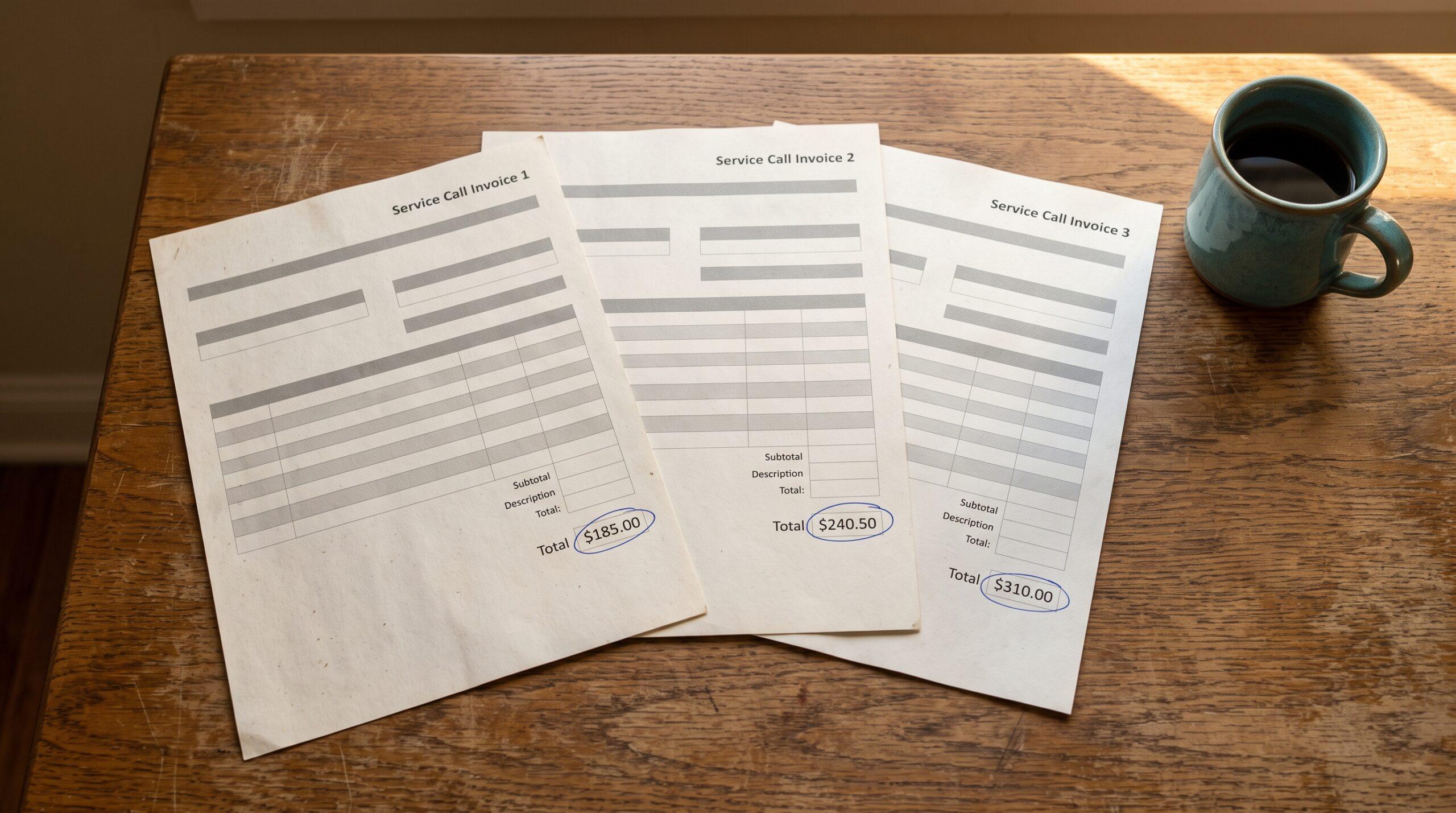
Flip the year around. If neither system had failed, the same homeowner would be out the full $600 premium with nothing to show for it beyond coverage that went unused. If only the water heater had failed, the year would cost $700 against a $1,348 repair, still a win, but a smaller one.
The fee structure does not change between those scenarios. What changes the math is how many separate systems actually break, and that number is never fixed in advance.
Budget for this as a range, not a flat number
Treat the premium as the only fixed cost in a home warranty plan. Treat the service fee as variable instead, scaling with how many separate systems fail in a given term, not with how many claims you expected to file when you signed up.
One failure costs the premium plus one fee. Three unrelated failures in the same year cost the premium plus three fees, even on an identical contract.
Before you sign, ask the provider two direct questions: whether the fee resets per system or per visit, and whether a denied claim still carries the charge. First American’s own contract language answers the first question in writing.
Choice Home Warranty’s terms, per NerdWallet, answer the second with a yes. Get both answers for your own plan before you assume either way.
For the full year-over-year math on whether a home warranty beats setting the premium aside in your own repair fund, see our home warranty versus repair fund break-even analysis. And before you file your first claim, read what actually triggers a denial in the fine print, covered in our guide to home warranty claim denials.
Frequently asked questions
Does a home warranty charge the service fee once a year or every time something breaks?
Every time, for the providers reviewed here. American Home Shield and Choice Home Warranty both describe the fee as due each time a technician responds to a service request.
NerdWallet’s 2026 reviews confirm this is each company’s own current language. A second, unrelated system failure in the same year triggers a second fee, not a shared annual charge.
What happens if the same system needs a second visit to fix the same problem?
First American’s own sample contract states that an additional service call fee is not due when multiple visits are needed to remedy the same home system or appliance. That protection covers repeat visits on one unresolved issue. It does not extend to a second, unrelated system that fails later in the term.
Do I still pay the service fee if the home warranty denies my claim?
Yes, at Choice Home Warranty. NerdWallet’s review states the technician visit fee is due even when the company denies the claim. Read your own plan’s contract language before assuming a denied claim means a refunded fee, since this detail varies by provider and is not confirmed for every company.
Does picking a higher service fee lower the monthly premium?
Yes, at American Home Shield. NerdWallet’s 2026 review lists a choice between a $100 and a $125 trade service fee, with the higher fee tied to a lower monthly premium. That tradeoff only pays off if claims stay infrequent enough that the premium savings beat the extra per-visit cost.
Should I budget for a home warranty as a fixed annual cost?
No. Budget the premium as fixed and the service fees as variable, scaling with how many separate systems fail that year.
One failure might cost $100 beyond the premium. Three unrelated failures in the same term could cost $300 or more in fees alone.