

7 min read · Last updated June 29, 2026
- A mid-tier home warranty runs about $650 a year, plus a $75 to $125 service fee per claim, so two claims cost roughly $850 before any repair value.
- Payout caps, often $1,500 to $3,000 per system, mean a failed $8,000 air conditioner may net you barely $1,300 after the cap.
- Bank that same $650 a year in a high-yield account and after about three claim-free years on a 15-year home, you usually come out ahead and you keep the cash.
- A warranty still wins if you have under $3,000 saved and cannot absorb a sudden $5,000 repair. In that case it is cash-flow protection, not a money-saver.
In this article
- What $650 a year actually buys you
- The cap problem: an $8,000 AC, a $1,300 check
- The self-funded account: same money, but you keep it
- The 15-year-home math: when the warranty wins
- The verdict: who should buy, who should self-fund
- FAQ
When Priya’s central air died the same summer her house turned fifteen, the replacement quote was $7,800. She did not have a home warranty, and writing that check stung. Her neighbor, who did have one, paid a $100 service fee and waited. Six weeks later the neighbor’s warranty company approved the claim and cut a check for $1,300, the cap on the policy. The neighbor still owed more than $6,000 out of pocket. Priya assumed the warranty had been the smarter move. The numbers say it was closer to a wash, and on a longer view, her instinct to self-fund may have been right.
The break-even math above assumes you pay for repairs yourself if you skip the warranty. USA.gov’s home-repair programs page lists legitimate assistance options if a repair still outpaces your fund, and HUD’s home improvements page is a federal baseline worth checking too.
What 650 buys
Start with the real cost, not the advertised one. A basic home warranty runs $300 to $600 a year. A comprehensive plan that actually covers your major systems runs $500 to $1,500. Call it $650 a year for a realistic mid-tier plan on an older home. That is the premium alone.
Then comes the service fee. Every time you file a claim and a technician comes out, you pay a service call fee, also called a trade fee, of $75 to $125. You pay it whether or not the technician fixes anything. File two claims in a year on a $650 plan and your true out-of-pocket is around $850 before you have received a single dollar of repair value.
The fee structure is not a scam, but it changes the math. A warranty is not free repairs for a flat annual price. It is a discount on repairs in exchange for a premium, a per-visit fee, and a ceiling on what the company will pay. That ceiling is where most of the disappointment lives.
The cap problem
Here is the detail that sinks most warranty math: the payout cap. Many plans cap what they will pay per system at $1,500 to $3,000, regardless of the real repair cost. Industry surveys put the most common denial and shortfall reasons as pre-existing conditions, items the plan does not cover, and claims that exceed the payout limit.
Run it against real replacement prices. A central air system runs $7,400 to $8,800 to replace. A furnace runs $3,200 to $3,800. If your plan caps air conditioner payouts at, say, $1,328, then a dead $8,000 system nets you $1,328 minus your service fee, and you cover the remaining $6,500 yourself. The warranty helped, but it covered less than a fifth of the bill. On smaller items the cap can erase the benefit entirely. A $600 dishwasher replacement against a $100 service fee and a plan you have already paid $650 for is not a saving at all.
This is the gap between how warranties are sold and how they pay. They are marketed as protection against the $8,000 disaster. The cap means they perform best on mid-sized repairs, the $800 to $2,000 range, and worst on the catastrophic failures people buy them to cover.
The self-funded account
Now the alternative nobody selling warranties wants to compare against. Take that same $650 a year and put it in a high-yield savings account earmarked for repairs. You pay no service fees. There is no cap. There is no claim to be denied for a pre-existing condition. And anything you do not spend stays yours and earns interest.
The compounding is the part the warranty comparison always skips. At roughly 4% in a high-yield account, $650 a year grows to about $2,050 after three years and about $3,600 after five, assuming you make no claims. A warranty over those same five years costs you $3,250 in premiums plus every service fee, and hands back nothing if your systems happen to hold. With the fund, a quiet five years leaves you with $3,600 in cash and full control. With the warranty, a quiet five years leaves you with receipts.
The self-funded account also covers what warranties exclude: the roof, the windows, the things outside the systems-and-appliances list. It is not protection against one named failure. It is a buffer against whatever the house throws at you. For how the two products differ at a structural level, see home warranty vs homeowners insurance.
| Factor | Home warranty | Self-funded repair account |
|---|---|---|
| Annual cost | ~$650 premium plus $75 to $125 per claim | ~$650 set aside, no fees |
| Payout ceiling | Capped, often $1,500 to $3,000 per system | None; you control the full balance |
| Covers a failed $8,000 AC | Up to the cap, often ~$1,300 | Whatever you have saved |
| Money left after a quiet 5 years | $0 | ~$3,600 plus interest |
| Covers roof, windows, structure | No | Yes, anything |
| Best for | Thin savings, cannot absorb a sudden $5,000 hit | Has or can build a real repair cushion |
The 15-year math
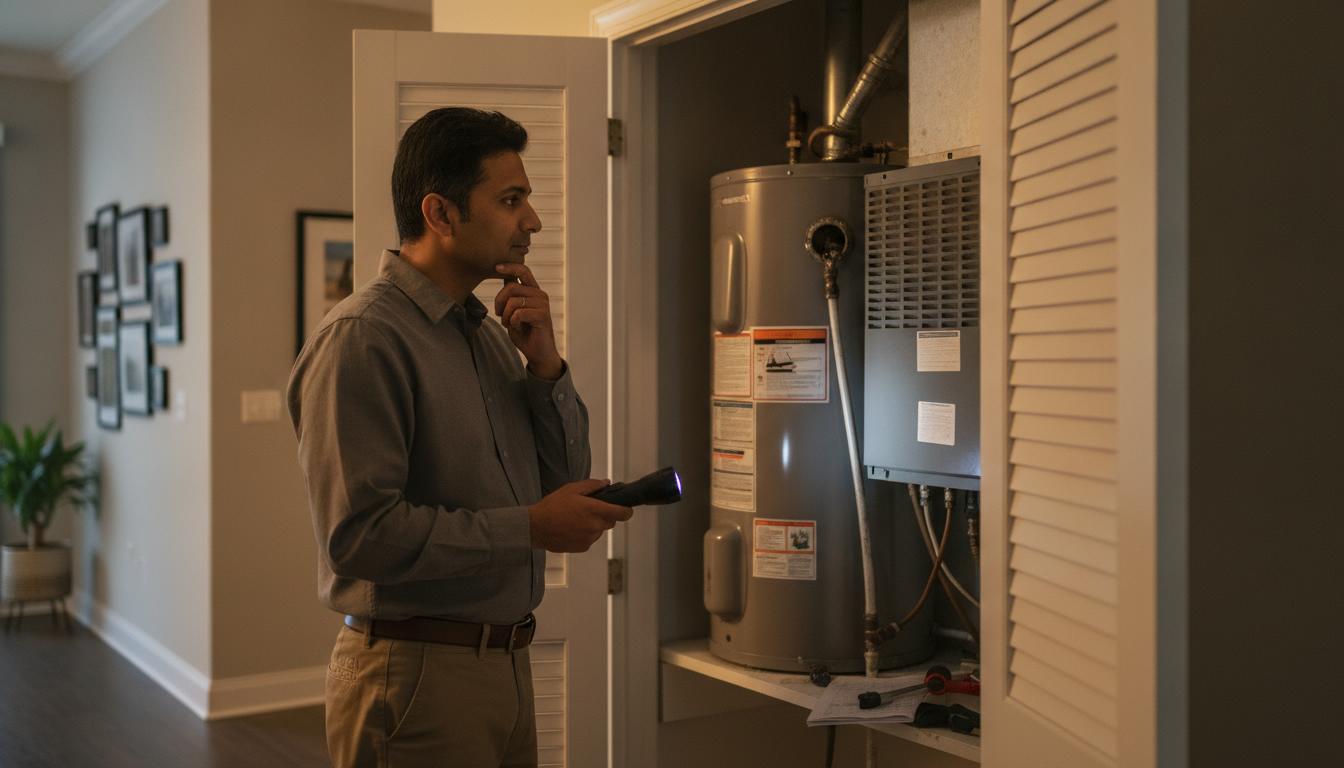
Why does a 15-year-old home change the calculation? Because that is the age where the expensive systems enter their replacement window all at once. A central air system typically lasts 15 to 20 years. A furnace runs 15 to 25. A water heater is often gone by 12. At year fifteen, you are no longer insuring against a freak failure. You are watching several systems approach the end of their service lives on a predictable timeline.
That cuts both ways, and this is the honest part. On a 15-year home, the odds that something major fails in the next few years are genuinely high, which is the strongest case for a warranty. But the same cap problem applies precisely when it matters most. When the aging air conditioner finally dies, the warranty pays its capped $1,300 and you cover the rest. The high probability of a claim does not help you if the payout is capped well below the replacement cost.
So the warranty’s best argument on an older home, that something is likely to break, is also where its cap does the most damage. It pays out often, but it rarely pays enough. For a full breakdown of what these plans actually run, see the real cost of a home warranty in 2026.
The verdict
Self-fund if you can. If you have or can build a repair cushion of $3,000 to $5,000, banking the premium yourself beats the warranty on a 15-year home in most years, because you keep the unspent money, you dodge the caps, and you cover repairs no warranty touches. The compounding does the rest.
Buy the warranty in one specific case: your savings are thin, under about $3,000, and a sudden $5,000 repair would mean credit-card debt or a missed mortgage payment. In that situation the warranty is not a money-saver, and you should stop evaluating it as one. It is cash-flow insurance. It converts an unpredictable $6,000 shock into a predictable $650 premium plus a service fee, and that predictability is worth paying for when you cannot absorb the shock. If that is you, compare plans on their coverage caps and exclusions, not their monthly price, because the cap is what determines whether the plan actually shows up when the system dies.
FAQ
Is a home warranty worth it on an older home? It depends entirely on your savings, not the home’s age. If you cannot absorb a sudden $5,000 repair, a warranty buys predictability and is worth it. If you have a $3,000 to $5,000 repair cushion, the payout caps usually make self-funding the better long-term math, even though an older home is more likely to need a repair.
What is a payout cap and why does it matter so much? A payout cap is the maximum the warranty will pay per system, often $1,500 to $3,000. It matters because major replacements cost far more. A capped $1,300 payout on an $8,000 air conditioner leaves you covering the other $6,500, which is why the cap, not the monthly price, is the number that decides whether a plan is useful.
How much should I keep in a self-funded repair account? A common target is 1% of your home’s value per year set aside for maintenance and repairs, with a goal of building a $3,000 to $5,000 cushion. On a 15-year-old home, push toward the higher end, because the major systems are entering the window where replacements cluster.
Why do warranty claims get denied? The most common reasons are pre-existing conditions, items the plan does not cover, exceeding the payout cap, and a lack of maintenance records. Getting a home inspection before buying a plan and keeping service records reduces denials, but the cap-related shortfalls are contractual, not a paperwork problem you can fix.
Can I switch from a warranty to a self-funded account later? Yes, and many homeowners do once they have built a cushion. A reasonable path is to carry a warranty while your savings are thin, then redirect the premium into a repair fund once you can absorb a major hit yourself. The two are not permanent commitments; they are tools matched to your current cash position.