
10 min read · Last updated June 02, 2026
- At year 12, a tank water heater has roughly a 30% chance of failure in year 13 and a 60% chance by year 15, per industry failure-probability data from plumbing contractors and ENERGY STAR guidance.
- A planned replacement runs $1,500-$2,500 installed; an emergency replacement after failure adds $5,000-$15,000 in water damage to the bill in 60-70% of tank failures.
- The federal Energy Efficient Home Improvement Credit (Section 25C) offers up to $2,000 toward a qualifying heat-pump water heater, changing the cost math significantly at year 10-12.
- Filing a homeowners insurance claim for a water heater failure can raise your premium for three years – sometimes more than the claim itself saves.
A water heater can continue working for years after it reaches the age when many homeowners start considering replacement. However, waiting too long can increase the risk of leaks, poor performance, and an unexpected loss of hot water.
If you’re wondering whether water heater replacement is necessary, the age of the unit is only one factor to consider. Its condition, efficiency, repair history, and signs of failure can help determine whether replacing it now or waiting longer makes more financial sense.
In this article
- The failure probability math at year 10, 12, and 15
- What the emergency scenario actually costs
- The tax credit that changes the math
- Brand quality, warning signs, and the sale-timing calculation
- FAQ
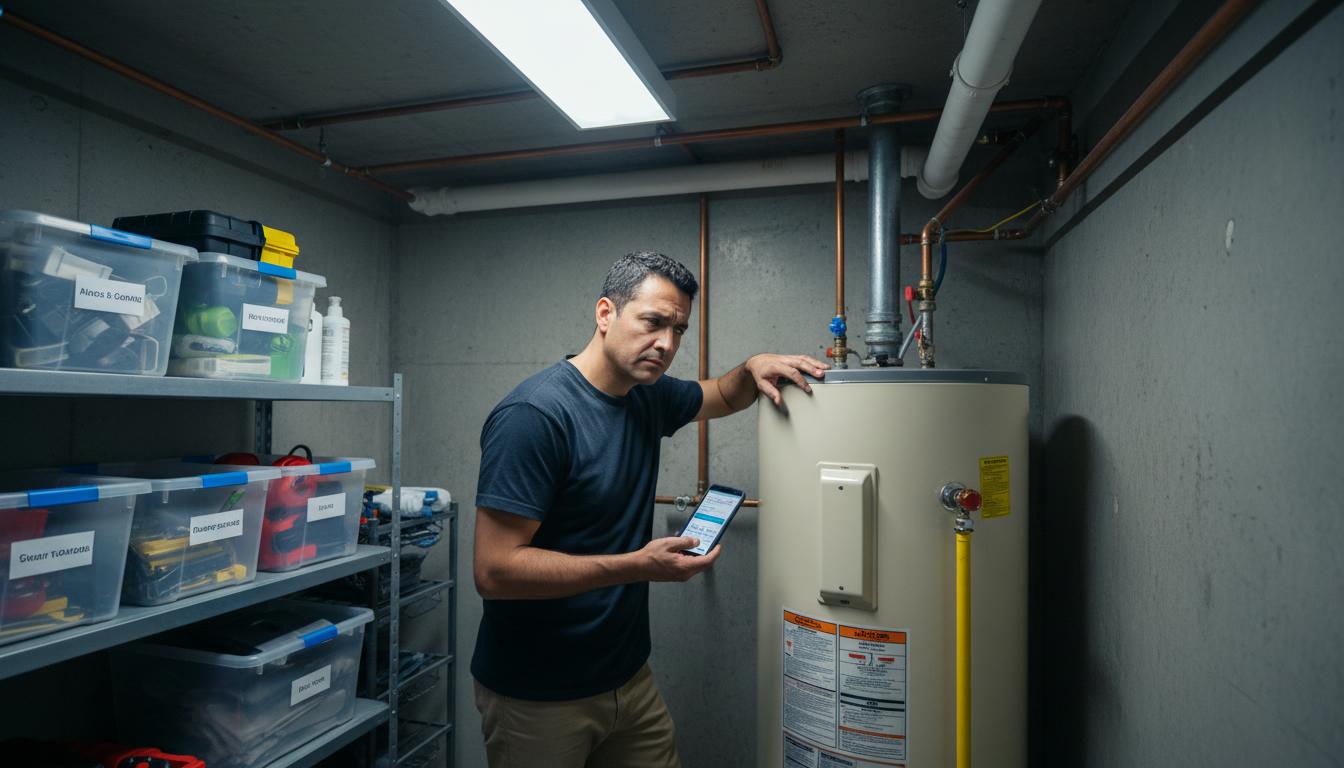
Today we bring you Marcus’ history. Marcus has a Bradford White water heater installed when he bought his home in 2013.
It runs fine. No rust, no leaks, nothing on the service history except an annual flush he does himself. He knows it’s 12 years old and has started thinking about it… But every time he asks his plumber friend, he gets “it’s still running, don’t touch it.”
Then last February, a neighbor two streets over came home from a weekend trip to a utility closet full of standing water and a 13-year-old water heater with a failed bottom fitting. The insurance claim covered the unit. The $9,400 in hardwood floor and drywall damage hit a $10,000 deductible.
At that point, Marcus’s friend called him the next day and said: “You should probably replace yours.”
Marcus’s neighbor paid his $10,000 deductible out of pocket, but a homeowner facing a similar replacement without insurance backing it has other options. USA.gov’s home-repair programs page lists legitimate assistance programs, and HUD’s home improvements page summarizes what federal funding actually covers.
Marcus’s friend was right. But not because the neighbor’s failure was scary… He was right because the math had already tipped.
The failure probability math at year 10, 12, and 15
ENERGY STAR and the Department of Energy put the useful service life of a traditional tank water heater at 8-12 years. Within that range, a unit from a budget brand (no-name contractor specials, big-box store exclusives) is realistically at end of useful life at 8-9 years.
Mid-range tanks (Rheem, A.O. Smith mid-tier) reach 10-11 years. Quality brands, such as Bradford White, Rheem Professional Series, A.O. Smith ProLine, can hold through 11-12 years when maintained.
After the 12-year mark, the failure probability curve steepens for every brand:
- Year 13: approximately 30% chance of failure during the year
- Year 14: approximately 45% chance
- Year 15: approximately 60% chance
These figures come from plumbing industry data compiled by contractors with high replacement volumes. They’re consistent with what ENERGY STAR’s guidance implies when it describes the 8-12 year service life as the window within which efficiency and reliability hold.
The failure distribution matters. 60-70% of tank failures involve significant water release, not just a loss of hot water.
A bottom fitting fails. The anode rod corrodes through the tank wall. A pressure relief valve seizes.
Any of these produces standing water before the homeowner knows anything is wrong.
What the emergency scenario actually costs
The cost difference between a planned replacement and an emergency replacement is not just the contractor markup for an after-hours call, though that’s real (typically $100-$300 in after-hours premium above standard rates).
The bigger exposure is the water damage that comes with 60-70% of tank failures.
A planned replacement of a 40-50 gallon tank runs $1,500-$2,500 installed in most markets, per data from HomeAdvisor and ENERGY STAR’s baseline estimates.
An emergency replacement for the same tank runs $2,000-$3,500. The premium reflects the urgency, the decommissioning of the failed unit, and potential water remediation before the new unit can be installed.
Add the water damage: drywall replacement, flooring (tile can be re-grouted; hardwood is rarely salvageable when it’s been wet for 24+ hours), mold remediation if the moisture sat, and any stored items in the utility closet.
The plumbing industry puts this exposure at $5,000-$15,000 for the typical utility closet or basement installation, with the upper end applicable to finished-space installations.
The comparison math:
- Proactive replacement at year 12: $2,000 installed, $0 water damage = $2,000 total
- Reactive replacement at year 14 failure: $2,800 emergency install + $8,000 water damage (median) = $10,800 total
- Expected savings from proactive replacement: $8,000-$10,000
The insurance angle is where most homeowners don’t look. Water heater leaks and burst pipes are among the top five most-claimed homeowners insurance events.
Filing a claim, even one that gets approved, goes on your claims history. In most states, one claim raises your premium at renewal. Two claims within three years in some states triggers non-renewal from carriers.
The math on whether to file vs. pay out of pocket is covered in when to file a homeowners insurance claim… But the smarter play at year 12 is not needing to make that decision at all.
More on planning for major repair costs at the home maintenance budget that saves you thousands.
The tax credit that changes the math
The Inflation Reduction Act created the Energy Efficient Home Improvement Credit (Section 25C of the Internal Revenue Code), which includes up to $2,000 for a qualifying heat-pump water heater installed in a primary residence. The credit applies to equipment costs and installation, and it’s a dollar-for-dollar tax credit, not a deduction.
Qualifying heat-pump water heaters are ENERGY STAR certified with a uniform energy factor (UEF) of 2.0 or higher. Units like the Rheem ProTerra or A.O. Smith HPTU-50N meet this threshold. Installed cost for these units typically runs $1,800-$3,000 before the credit.
After the $2,000 credit, the effective out-of-pocket for a heat-pump replacement at year 12 can be below the cost of a standard tank unit… While delivering 50-70% lower energy costs than a resistance electric heater (ENERGY STAR’s estimated operating cost comparison).
For homeowners with electric water heaters planning to stay in the home, the heat-pump upgrade at year 12 is often the economically correct choice.
The credit is claimed on IRS Form 5695 for the tax year the installation occurs. Confirm eligibility with a tax professional – the credit phases out for certain income levels and has annual aggregate limits across all Section 25C improvements.

Brand quality, warning signs, and the sale-timing calculation
The brand adjustment matters for timing. If you have a Bradford White or comparably-rated unit and it’s currently at year 11 with no symptoms, you have more runway than a budget brand at year 9. But the runway is months, not years – and you should be monitoring actively.
Warning signs that mean replace within weeks, not months:
- Discolored or rusty hot water (anode rod failure, tank corrosion)
- Persistent rumbling or popping during heating cycles (heavy sediment buildup – the #1 cause of premature failure per ENERGY STAR guidance)
- Visible moisture or pooling at the base of the tank
- Inconsistent water temperature despite no thermostat changes
- Age 13+ regardless of brand and regardless of symptoms
If you’re planning to sell within 18 months and your water heater is 11-12 years old, replacing it proactively costs $2,000 and eliminates the topic from every buyer inspection conversation.
A buyer’s inspector who notes a 13-year-old water heater creates a negotiation point worth far more than $2,000 in typical markets. A $2,000 replacement now is cheaper than a $3,000 seller concession later.
For homeowners who haven’t had a contractor in for other work recently, vetting one before you need emergency service is the right first step. The how to vet a contractor checklist covers licensing, insurance, and quote comparison in detail.
FAQ
How do I know how old my water heater is?
Check the serial number on the unit’s label, typically a sticker on the upper third of the tank. Most manufacturers encode the manufacture date in the first few characters of the serial number. Bradford White uses the first letter for month (A=January, B=February, etc.) followed by a digit for year. A.O. Smith and Rheem use similar but slightly different encoding. If you can’t decode it, call the manufacturer with the model and serial number. They can tell you the manufacture date immediately.
Is it worth repairing a 12-year-old water heater?
The 50% rule gives a quick answer: if the repair cost exceeds 50% of the cost of a new unit, replace it. At year 12, a repair that keeps a tank running for another 6-18 months before failure costs almost as much as the replacement you’re delaying… And the replacement doesn’t include water damage exposure. For most repairs on a 12-year-old unit, replacement wins the math.
What’s the difference between a heat-pump and a tankless water heater?
A heat-pump water heater uses electricity to move heat from the surrounding air into the water, consuming 50-70% less energy than a resistance electric heater. A tankless heater (gas or electric) heats water on demand without storing it in a tank, virtually eliminating standby energy loss. Heat-pump units qualify for the Section 25C tax credit. Tankless units may qualify for a separate $600 credit. Both have higher upfront costs than a standard tank but lower operating costs over time.
Does my homeowners insurance cover a water heater failure?
Sudden and accidental water damage caused by a water heater failure is typically covered by the water damage or sudden discharge provision in a standard homeowners policy. The water heater unit itself is usually not covered (it’s maintenance-related). However, filing a claim affects your premium history. If the failure damage is near your deductible, paying out of pocket protects your claims record.
How much does an emergency water heater replacement cost vs a planned one?
Planned replacements for a standard 40-50 gallon tank typically run $1,500-$2,500 installed. Emergency replacements run $2,000-$3,500 for the unit and install alone, before any water damage remediation. Add $5,000-$15,000 for water damage in a typical utility closet or basement installation, with the upper end for finished-space failures.
Related guide: Your AC Is 12 Years Old and Straining Through This Heat Wave. Repair Again or Replace Now?