
8 min read · Last updated November 2, 2026
- State Farm, Amica, and the District of Columbia’s own insurance regulator all name the same floor: keep an empty house at 55°F or higher, not 68°F and not 50°F.
- State Farm’s own guidance flags 20°F outside as the point where frozen-pipe risk climbs sharply, even with the heat running.
- A frozen-pipe claim is not automatically covered just because you were away. Standard policies pay out only if you took “reasonable care” to maintain heat, and a thermostat set too low is the evidence insurers use to say you did not.
- Shutting off the water main and draining the system removes the freeze risk, and the coverage question, no matter how cold it gets or how long you’re gone.
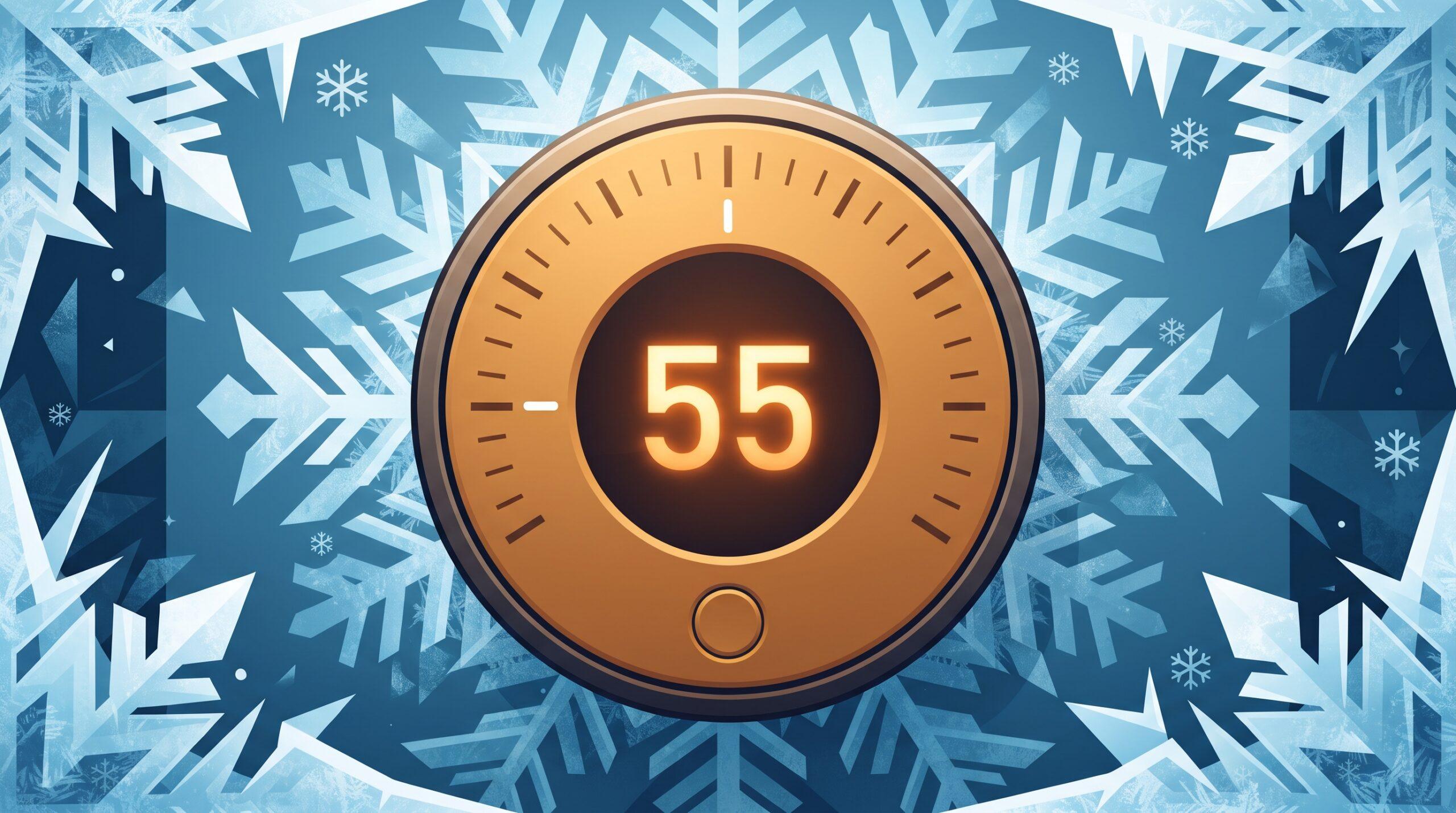
The thermostat setting to prevent frozen pipes while you’re away is 55°F or higher, in every room, for the whole trip. That is the floor named by State Farm, Amica, and the District of Columbia’s own insurance regulator.
In this article
- What your insurer means by “maintaining heat”
- The thermostat setting that prevents frozen pipes
- The decision: thermostat alone, or drain the system
- What actually happens when a claim gets denied
- Frequently asked questions
Imagine you are leaving for a ten-day trip over the holidays. You turn the thermostat down to save on the heating bill, maybe to 50°F, figuring the house will still be warm enough. If a pipe freezes and bursts while you’re gone, that one number on the thermostat can decide whether your insurer pays for the damage or denies the claim.
What your insurer means by “maintaining heat”
Standard homeowners policies cover sudden water damage from a burst pipe. They do not automatically cover it if the insurer decides the freeze happened because you failed to take reasonable care of the property. The District of Columbia’s Department of Insurance, Securities and Banking (DISB), the agency that regulates insurers doing business in DC, puts it plainly for residents: “Your policy usually requires that heat be maintained within the property, and some policies require that you maintain a certain temperature, even if the property is vacant, occupied or unoccupied.”
“Reasonable care” is not defined by a single number in most policies. It is defined by what you can show after the fact. Amica, a national insurer, states it directly on its own site: “Homeowners policies generally cover loss due to freezing of plumbing only if reasonable care was taken to maintain heat in the home.”
A thermostat you can prove was set to 55°F or higher is evidence of reasonable care. A thermostat set to 50°F, or a furnace that was shut off entirely, is evidence of the opposite.
The thermostat setting that actually prevents frozen pipes
You do not need to pay to heat an empty house to a comfortable temperature. You need to keep it above the number insurers actually use. DISB’s own consumer guidance tells residents to “keep room temperature around 69 degrees or no lower than 55 degrees in all areas of the property.” Amica recommends the same floor: “it’s recommended to set your thermostat to 55 degrees Fahrenheit or higher” while away, specifically because that keeps “the interior of the floor and wall cavities – where your plumbing is often located – safely above freezing temperatures.”
State Farm sets the identical number for its own policyholders: “Ensure your home maintains adequate heat inside, at least 55 degrees.” The insurer also names the temperature where the real danger starts: “When temperatures in southern climates dip below 20 degrees Fahrenheit, pipes can freeze and burst.”
Below that 20°F mark, a 55°F setting stops being a comfort margin and becomes the only thing between you and a burst pipe. That same State Farm guidance cites Insurance Information Institute data on frequency: roughly one in 50 insured homes files a water or freezing claim every year.
Pipes running through an uninsulated attic, crawl space, or exterior wall freeze faster than interior pipes at the same indoor air temperature, since they sit closer to the outside cold. If your home has any of those, 55°F is a floor, not a guarantee.
The decision: thermostat alone, or drain the system
Shutting off the water main and draining the pipes removes the freeze risk completely. It also means no running water when you get back until you turn it on and refill the system. Whether that trade is worth it depends on three things you already know before you leave: how long you’ll be gone, how cold it’s forecast to get, and whether anyone can check on the house.
| Your situation | Recommended action | Why |
|---|---|---|
| Away 1-3 nights, forecast lows stay above 20°F | Set the thermostat to 55°F or higher and go | Meets the reasonable-care floor named by DISB, Amica, and State Farm; draining is unnecessary extra work for this short a window |
| Away 4-7 nights, lows dip into the 10-20°F range, someone can check the house | Thermostat at 55°F or higher, plus a neighbor or house-sitter checking every 2-3 days | Still above the floor, but a mid-trip check catches a failed furnace before a week of unattended cold does the damage |
| Away 8 or more nights, lows forecast below 10°F, or nobody can check the house | Shut off the main and drain the system | State Farm’s own guidance flags sub-20°F as the real danger zone; a week or more unattended at that temperature is exactly the gap a thermostat alone cannot cover |
| Any trip length, home has pipes in an uninsulated attic, crawl space, or exterior wall, or a history of freezing | Drain the system every time you leave for more than a night | These pipes freeze faster than the rest of the house regardless of the thermostat setting, so the 55°F floor cannot be trusted to protect them |
Draining the system means more than turning a valve. Do it in this order:
- Shut off the main water supply.
- Open every faucet, including outdoor spigots, and let them run dry.
- Flush each toilet to clear the tank and bowl.
- Add plumbing antifreeze to toilet bowls and drain traps so the water sitting in the trap doesn’t freeze and crack the fitting.
A water heater needs its own drain valve opened separately. If any of that is unfamiliar, hand it to a plumber for one visit rather than risk doing it wrong.
A smart leak sensor with an automatic shutoff valve is a different tool: it reacts after water starts moving, not before a freeze starts.
What actually happens when a claim gets denied
A frozen-pipe denial rarely says “you kept the thermostat too low” in those exact words. It says the loss falls under the policy’s freezing exclusion because you did not take reasonable care to maintain heat, or because the home was vacant and unheated past the policy’s own conditions for vacancy.
The insurer is not required to prove you did something wrong beyond a reasonable doubt. It only has to show the exclusion applies, and the evidence it leans on is whatever record exists: a smart thermostat’s logged temperature history, a utility bill showing the furnace barely ran, or a neighbor’s statement that the house looked and felt cold.
That is the same reasoning behind a home warranty denial for missing maintenance records: the company isn’t asking whether you meant to take care of the system. It’s asking whether you can show that you did. If a pipe does burst despite everything you did right, the immediate steps matter as much as the prevention did; our guide to what to do when a pipe bursts covers shutting off water, documenting the damage, and starting the claim the right way.
If your home has already had repiping work done because of past freeze damage or corrosion, make sure that history and any carrier nonrenewal notice tied to it are something you can point to as evidence the plumbing itself, not your winter habits, was the real risk factor.
Frequently asked questions
What temperature should I set my thermostat to when I leave home for the holidays? Keep it at 55°F or higher in every area of the house. That is the floor named by DISB, Amica, and State Farm alike. DISB’s own guidance allows up to 69°F if you’d rather not cut it close, but 55°F is the documented minimum insurers treat as reasonable care.
Is 68°F safer than 55°F for an empty house? It gives you more of a buffer, but it also costs more to heat a house nobody is in. 55°F is the number insurers actually require; anything above that is a personal comfort-versus-cost choice, not an insurance requirement.
Do I have to drain my pipes if I’m only gone for a weekend? Usually not. If forecast lows stay above 20°F and the thermostat is set to 55°F or higher, a two or three-night trip falls well within what insurers consider reasonable care. Draining becomes worth the effort on longer trips or in deeper cold.
Will my homeowners insurance deny a claim just because the house was empty? Vacancy alone usually isn’t the reason. The denial comes from failing to maintain heat or drain the system while the house was empty, which policies frame as a lack of reasonable care, not from the absence itself.
What’s a maintenance record for a thermostat, and do I need to keep one? Many smart thermostats log their own temperature history, which can serve as proof of what you actually set. If yours doesn’t, a photo of the thermostat display before you leave and a utility bill showing continued heating use both help the same way.